Why the Palm Springs Leased-Land Discount Is Really a Bet on Your Landlord
September 3, 2026
September 3, 2026
"I don't think many people here have $100,000."
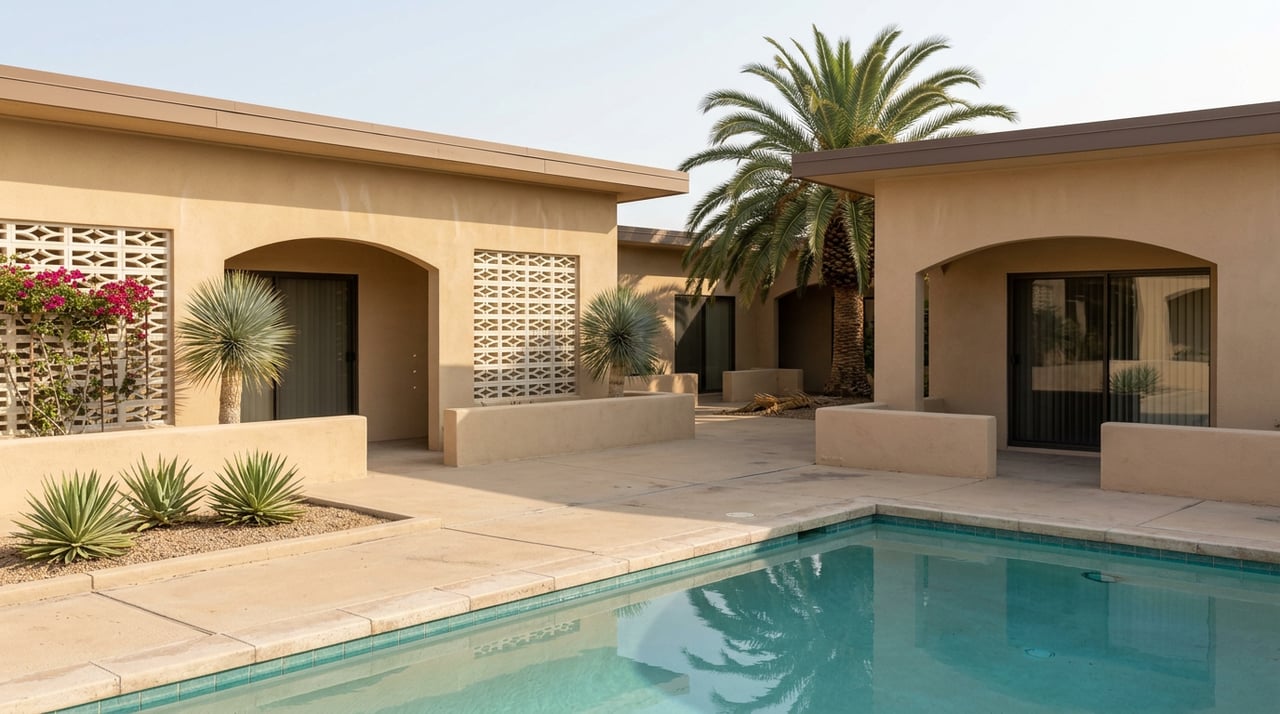
That's Dave Buck, HOA president at Saddlerock Estates, a 24-unit mid-century condo community off Palm Canyon Drive near Via Sonoma in south Palm Springs. Buck has lived there for nearly two decades. In June 2025, he and 23 neighbors got a letter that changed the math on everything they thought they knew about their homes.
Saddlerock Estates sits on land leased from a member of the Agua Caliente Band of Cahuilla Indians, a common arrangement in a city where roughly 6,700 acres still belong to the tribe under a 19th-century checkerboard grant. The homeowners don't own the ground under their units. They lease it, and their current lease runs through 2042. To extend it, the landowner, William McGlamary, proposed a new sublease stretching 52 years further, priced at $100,000 per unit due by December 31, 2025, plus an immediate jump from $200 a month to $650, then increases of 20 to 30 percent every five years after that.
Twenty-two of the 24 owners said no.
If you're comparing Palm Springs to other Coachella Valley cities right now, you've probably already noticed that certain condos and homes here price well below what the architecture and location would suggest anywhere else. The Saddlerock story is the clearest illustration we've found of why that discount exists and why it isn't the sure thing it looks like on a listing sheet.
Palm Springs sits inside a reservation pattern set in 1876, when the federal government deeded alternating square-mile sections to the Pacific Railroad and to the Agua Caliente Band during the railroad's build-out between Los Angeles and Yuma. The tribe ended up with land in a checkerboard across the valley, with roughly 6,700 acres of it inside city limits. Homes built on those sections are leasehold, not fee simple. You own the structure. You lease the dirt.
That structure is why leased-land homes typically list 15 to 30 percent below comparable fee-simple properties nearby. You aren't paying for the land, only the improvements, which also means your property tax bill is generally based on the structure's value rather than the underlying lot. For a second-home buyer chasing a specific mid-century floor plan or a specific view, that gap can be the difference between owning here and not.
None of that is a secret, and none of it is the interesting part. The interesting part is what happens at renewal, because that's where the discount either holds or evaporates, and the landowner, not the market, makes that call.
Here's the mechanical piece that catches remote and out-of-state buyers off guard. Lenders will not write a mortgage that outlives the lease. The Bureau of Indian Affairs' Palm Springs Agency holds approval authority over leasing on the Agua Caliente reservation, and the industry convention that's grown up around its leases is straightforward: the remaining term needs to run roughly five years past your loan's maturity. A 30-year mortgage wants at least 35 years left on the lease. A 15-year mortgage wants at least 20.
Jim Franklin, government affairs director for the Greater Palm Springs Realtors, put it plainly to a local news crew a few years back: once a lease drops under that 35-year threshold, standard 30-year financing disappears, and buyers get pushed toward shorter amortizations, portfolio lenders, or cash. That's a real number, not a lifestyle preference, and it means two homes that look identical on a listing can carry very different price ceilings depending on where their lease sits in the countdown.
This is exactly why renewal negotiations tend to start once a lease nears that 35-year mark, and why the outcome of those negotiations matters so much more than the sticker price you're comparing against a fee-simple home three blocks away.
What makes Saddlerock worth understanding isn't that a landowner asked for more money. It's how differently that ask landed compared to neighboring communities built around the same time, on the same kind of tribal lease, just with different individual landowners.
| Community | Renewal fee | Terms |
|---|---|---|
| Saddlerock Estates | $100,000 per unit (proposed) | Immediate increase to $650/month, then 20-30% every five years; rejected by 22 of 24 owners |
| Sunshine Villas | $10,000 one-time | Lease renewed through 2076; monthly rate rises to $662 starting in 2042 |
| Mission Hills (Rancho Mirage) | $15,000-$18,000 | Cited as a comparable renewal range in the same reservation system |
| Parc Andreas | $12,000 | Cited as a comparable renewal range in the same reservation system |
Sunshine Villas was built around the same era as Saddlerock, on a lease held by a different tribal member. Its renewal, reached the year before the Saddlerock letter went out, cost each owner a tenth of what McGlamary asked for and locked in decades of stability. Same city, same reservation, same general lease structure, completely different outcome, because the terms are set individually by whichever tribal allottee owns that particular parcel. There's no valley-wide formula. There's no regulator setting a ceiling. Each negotiation is its own contract between an HOA and a private landowner, and the BIA's role is approval, not price-setting.
This isn't a settled case you're reading about after the fact. As of the most recent reporting, it's still moving.
After homeowners refused the June 2025 offer, Hallview Management, the company that co-signed the original master lease covering Saddlerock and two other Palm Springs communities on tribal land, filed a formal appeal with the Bureau of Indian Affairs in February 2026. Hallview's position is that McGlamary bypassed the master lease by negotiating directly with individual homeowners instead of going through the co-signing management company. In May 2026, a tribal court dismissed a separate lawsuit McGlamary had filed against Hallview over that appeal, ruling on jurisdictional grounds without touching the underlying question of whether the successor leases are valid. As of that ruling, the Bureau of Indian Affairs had not yet issued a decision on Hallview's underlying appeal, and the larger dispute over whether the successor leases are enforceable remains open.
Meanwhile, homeowners like Debby Luna, who has lived in her Saddlerock home for 17 years, have put their properties on the market simply to get something out of them before the 2042 deadline arrives. Others, like retired teacher Lisa Lenes, whose parents bought the unit more than four decades ago, describe being caught between a lease they can't afford to renew and a home they can't easily sell to someone who understands what they're buying.
We're not sharing this to alarm anyone away from leased land. Plenty of leaseholds in this valley renew quietly, on reasonable terms, for a fraction of what Saddlerock was asked to pay. We're sharing it because the difference between those two outcomes is exactly the risk a buyer needs to price in before falling for a lower number on a listing.
If you're weighing a Palm Springs property against homes in other Coachella Valley cities and you notice a meaningfully lower price, ask the fee-or-lease question before anything else. A title report or a check through the Bureau of Indian Affairs Palm Springs Agency will confirm whether a specific parcel sits on tribal trust land, and if it does, you want the recorded lease itself, not a summary of it, showing the remaining term, the rent schedule, and who the individual landowner is.
Talk to a lender experienced with Palm Springs leaseholds before you get attached to a property, not after you're in escrow. Ask specifically where the lease sits relative to that 35-year financing threshold, because that single number determines whether you're shopping the whole buyer pool or a much smaller one. And if you're buying into an HOA on leased land, ask whether the association has anything set aside for a future renewal. Saddlerock's fight shows what happens when that conversation gets forced by a deadline instead of planned for years in advance.
None of this makes leased land a bad decision. For the right buyer and the right timeline, it's still one of the more accessible ways into a Palm Springs address. It just means the discount on the sign is the first of two numbers you're underwriting, and the second one belongs to a landowner you haven't met yet.
Can I negotiate a lease extension myself before I close on a leasehold property? Generally no. Extensions are handled at the HOA or master-lease level, not by individual unit owners, which means your leverage as an incoming buyer is limited to whatever term already exists on the property you're purchasing.
Does every Agua Caliente lease behave like Saddlerock's? No. Sunshine Villas, built the same era and on the same general reservation system, renewed for a tenth of the fee Saddlerock was asked to pay. Terms are set individually by each landowner, so a neighboring complex's experience is not a reliable predictor of yours.
How do I find out if a specific Palm Springs address is on leased land? Start with a title report and confirm directly with the Bureau of Indian Affairs Palm Springs Agency, which holds approval authority over leasing on the reservation and can verify a parcel's status.
If you're comparing neighborhoods across the valley and want a clear read on which specific addresses carry lease risk and which don't, that's exactly the kind of groundwork we do before you ever write an offer. Levi Knapp and the team work these questions block by block, not from a spreadsheet. Schedule Your Concierge Consultation and let's go through the lease history on any property you're seriously considering before it becomes a surprise at underwriting.
Stay up to date on the latest real estate trends.
Whether buying your first desert retreat or selling a signature property, Levi Knapp delivers a seamless and sophisticated experience every step of the way.