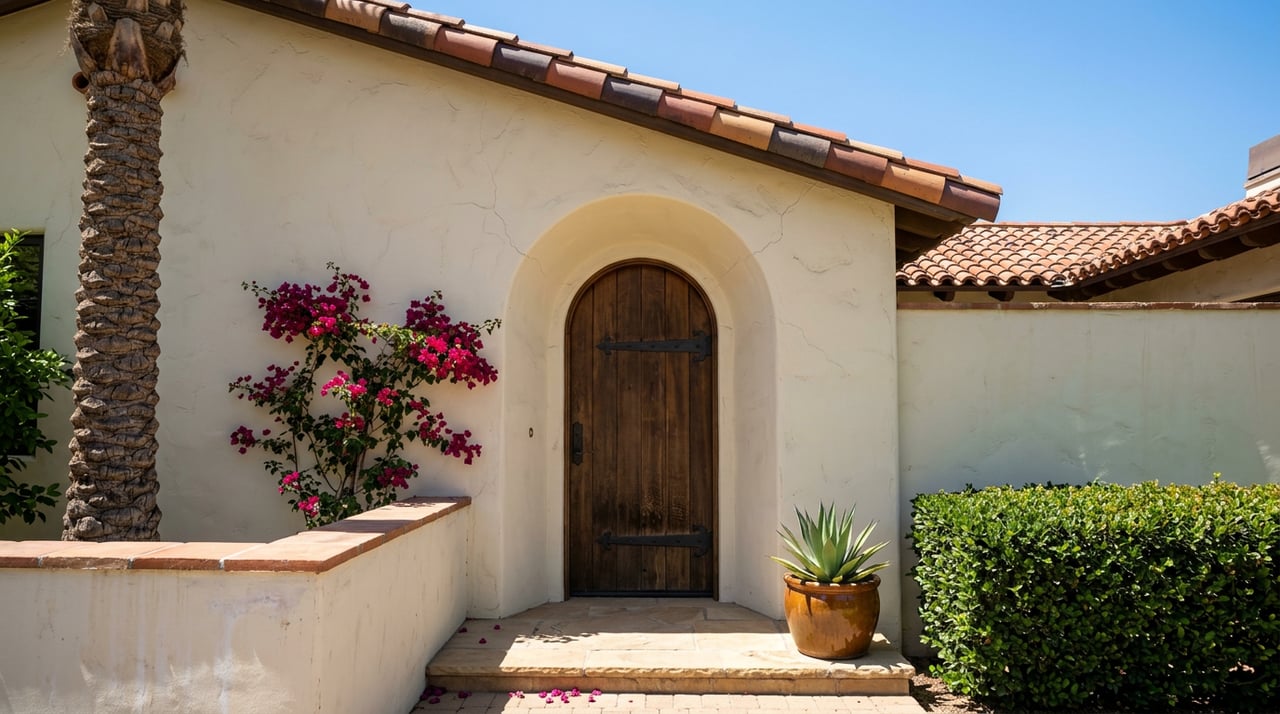
In Palm Springs, the Historic Plaque Is a Trade, Not a Trophy
September 24, 2026
September 24, 2026
"Not every single one of the 524 are pursuing Mills Act contracts, nor would we necessarily work with them to do so."
That's Palm Springs Planning Director Chris Hadwin, addressing the city council in March after they approved Class 1 Historic Site status for a 1930s estate at 1752 Ridge Rd., a property with ties to Hollywood director Edmond Goulding. The buyer, Lucien Wolff, had told the council he knew the house needed significant restoration when he bought it. The designation passed. Then Mayor Naomi Soto asked Hadwin to walk the council through what the Mills Act program actually costs the city and what it buys the homeowner. That question, asked out loud in a public meeting, is the one every buyer of a Palm Springs mid-century or Spanish Revival home should be asking before they write an offer, not after.
Here is the trade nobody puts on the listing sheet: a historic designation can cut your property tax bill by 40 to 70 percent. It can also mean you need a Certificate of Appropriateness from the Historic Site Preservation Board before you touch the roofline, the windows, or in some cases the landscaping. Two houses that look identical from the street, same era, same architect, same block, can carry two entirely different sets of rules and two entirely different real costs of ownership, depending on which side of that designation line each one sits.
As of mid-July 2026, Palm Springs had 133 Class 1 historic designations citywide. Roughly 75 to 80 of those are single-family homes. The rest are commercial buildings, civic structures, and churches. But the pool of homes that could be designated is much bigger: Hadwin told the council the city currently has 524 properties eligible for a Mills Act contract, of which 177 already have one and 14 more are in process. The city processes about 12 new applications a year.
Using the city's median annual property tax assessment of $4,250 as a baseline, Hadwin estimated the typical rebate lands between $1,700 and $3,000 a year. Multiply that across the roughly dozen contracts the city approves annually and you get a reduction in the property tax base of about $20,000 to $35,000 a year, every year, compounding. Over ten years, factoring in contracts already on the books, Hadwin projected the cumulative impact could reach $300,000 to $500,000, with another $357,000 expected from contracts not yet issued. That is real money leaving the county tax rolls and staying in homeowners' pockets, which is exactly what the state legislature intended when it passed the Mills Act in 1972. Planning staff have said they plan to bring a broader discussion of the historic preservation ordinance back to the council as part of an upcoming zoning code update, so the mechanics of this trade are not fixed in stone.
The tax break is not the whole story. Before any demolition or alteration of a Class 1 or Class 2 historic resource, the owner needs a Certificate of Appropriateness, and the city won't issue a building or zoning permit for that kind of work without one in hand. The review sits with the Historic Site Preservation Board, which meets alongside the city's Architectural Review Committee on a regular monthly schedule. That means a new roof, a window replacement, or a change to a courtyard wall on a designated home goes through a layer of review that a non-designated house two doors down simply doesn't face.
This is not a hypothetical for Palm Springs buyers. The city's mid-century inventory is full of houses by Donald Wexler, William Krisel, William Cody, and E. Stewart Williams, and many of the most desirable examples already carry Class 1 or Class 2 status. Sinatra's Twin Palms, designed by Williams in 1947, is one of the most photographed Class 1 sites in the city. The Cary Grant House on North Avenida Palmas, designated in 2011, and the Kramer Residence, designated in 2019, sit in the same category. None of that history depresses value. In early 2026, the Wexler Residence in Movie Colony East, a Class 1 Historic Resource, sold for $3.57 million. White Shadows, a Moroccan-influenced Thunderbird Heights villa, sold for $5.3 million with its Mills Act designation passing to the new owner. Designation and price appreciation are not in tension. The tension is between the tax savings and your freedom to change the exterior without a hearing.
Not every Palm Springs neighborhood carries the same designation density, and that changes what a buyer should expect to research before making an offer.
| Neighborhood | What the price data shows | What designation means here |
|---|---|---|
| Old Las Palmas | Median sale price around $2.76 million, with estate properties reaching $7 million or more (current 2026 listing data) | Large lots and eight decades of architectural styles, from 1920s Spanish Colonial estates to mid-century work by Wexler and Williams. Several designated properties, but scale means fewer identical comps. |
| Vista Las Palmas | Roughly $2 million to $3.7 million for restored or original-condition homes (May 2026 active listing data) | Many homes here qualify for Class 1 or Class 2 status. Buyers drawn to Krisel-designed originals are often looking at homes already carrying the restrictions along with the tax benefit. |
| Movie Colony | Priced on condition, architectural provenance, and designation status rather than a single band | About 170 homes total, several already Class 1, including the Rachel de Brabant Residence and the Cary Grant House. Smaller lots than Old Las Palmas, closer to the street. |
| Racquet Club Estates | Restored Alexander homes citywide have recently sold from the mid-$900,000s up to $2.0 million | Alexander Construction Company tract built in the late 1950s with designs by Krisel and Dan Palmer. A concentration of near-identical floor plans makes the presence or absence of designation on a specific unit easy to miss during a quick showing. |
The takeaway isn't that one neighborhood is a better bet than another. It's that price alone tells you nothing about whether the house you're touring already carries a Mills Act contract, is mid-application, or was passed over entirely. That detail lives in the city's planning files, not the MLS sheet.
A handful of questions turn this from a surprise into a plan:
Does the Mills Act contract stay with the house when it sells? Yes. The contract transfers to the new owner, along with both the tax savings and the maintenance obligations that came with it.
Can a homeowner remove a historic designation to renovate freely? Designation is a City Council action, not a personal choice you can undo on a whim. Removing it would require its own process through the Historic Site Preservation Board and council, and there's no guarantee of approval.
Does a historic designation lower resale value? Recent sales don't support that. Designated mid-century homes by architects like Wexler have sold well into seven figures, and buyers specifically seeking architect-attributed originals often view the designation as part of the appeal, not a drawback.
The plaque on a Palm Springs historic home is a real financial benefit and a real constraint at the same time. Knowing which rooms you can change and which ones you can't, before you're three weeks into escrow, is the difference between a smooth close and a frustrating one.
If you're weighing a mid-century or historic property in Palm Springs and want someone who can pull the designation history and Mills Act status before you write an offer, reach out to Levi Knapp to schedule your concierge consultation.
Stay up to date on the latest real estate trends.
Whether buying your first desert retreat or selling a signature property, Levi Knapp delivers a seamless and sophisticated experience every step of the way.